The outline of a print is one of the first things the eye registers. A square may gather attention around a centre, a portrait can lead the gaze up and down, and a landscape can encourage it to travel across the wall. None of these shapes guarantees a particular mood. Their effect depends on the relationship between the print and what surrounds it: the clear wall, the furniture below, nearby doors or windows, and the position from which you normally see it.
That makes orientation a practical choice rather than a personality test. Before deciding between square, portrait and landscape wall art, look at the wall as an arrangement of real boundaries. Begin with the orientation that leaves clear space between the planned print and those boundaries.
How shape guides attention without dictating emotion
Our visual system does not judge every direction in exactly the same way. In controlled studies, vertical line segments have sometimes been perceived as longer than equal horizontal ones. That finding can help explain why a tall outline may appear to claim height, but it does not prove that portrait art is always dramatic or that landscape art is always restful. Subject, scale, contrast, light and the room itself all affect the result.
A better question is: where does this shape send your attention on this particular wall? Portrait proportions can reinforce a narrow rise between architectural features. Landscape proportions can follow the width of a desk or sideboard. A square has no dominant horizontal or vertical direction, so it can create a contained focal area where the available wall is closer to equal in height and width.
Use low-tack tape to mark the exact listed outer dimensions. Leave it in place long enough to check it from a seat, as you enter the room and while moving through the nearest doorway. An outline that works only when you stand directly in front of it may feel less resolved in daily use.
A square can establish a contained centre
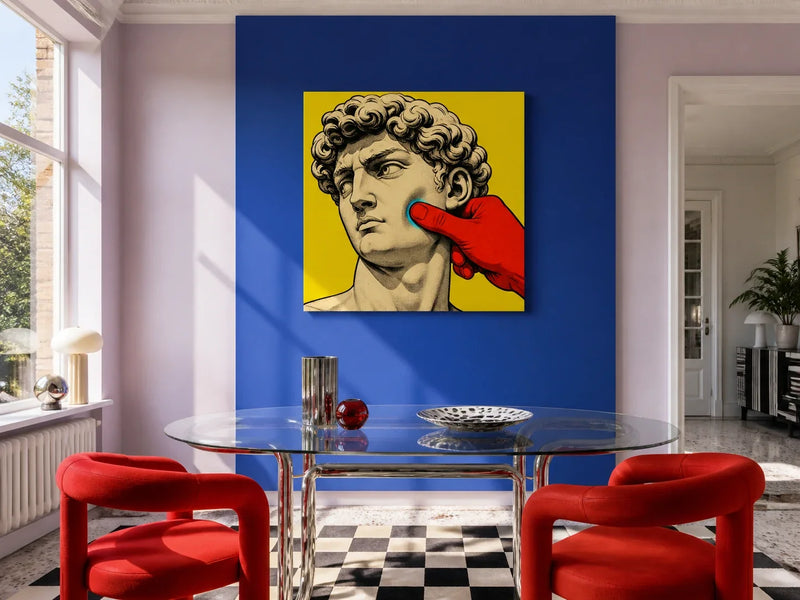
A square often suits a chimney breast, a compact section between shelving, or a clear wall whose width and height feel similarly bounded. Its equal sides can gather the image into one central area rather than pulling the eye strongly in either direction. That quality may make a square useful when the wall already contains long lines from a sofa, dado rail or shelf.
Escape the Mould Canvas places a David bust breaking through a plaster mould inside a 1:1 composition. It is available in 40 x 40 cm, 60 x 60 cm and 80 x 80 cm. Compare at least two taped squares on the intended wall. The smaller option may sit neatly within a compact section of wall, while the larger one needs enough clear plaster for the broken edges and fragments to remain legible from your usual seat.

The equal sides of Escape the Mould Canvas establish a centred area above the sofa without copying its long horizontal line.
 Escape the Mould Canvas
Portrait art can work with vertical architecture
Portrait orientation can use a tall strip of wall that a square leaves underfilled. Look for the vertical shapes already present: the space above a slim console, the end of a hallway, a pier between doors, or a stair wall seen from below. A portrait print can follow that rise, provided its outer edge does not crowd a light switch, door frame, picture rail or ceiling.
Camera In Colour Canvas is a portrait canvas with a black film camera at the centre of geometric colour blocks. Its sizes are 20 x 30 cm, 40 x 60 cm, 60 x 90 cm and 80 x 120 cm. On a hallway wall, test the outline while approaching from both directions. A larger portrait can appear well balanced from the far end yet feel too close once you stand beside the console, so the walking view matters as much as the face-on view.

The portrait proportions of Camera In Colour Canvas use the narrow wall between two doorways while keeping the walking route clear.
 Camera In Colour Canvas
Landscape art can follow a wider field of view
Landscape orientation can make sense where the usable wall is wider than it is tall, particularly above a long desk, sideboard or low piece of furniture. The horizontal outline encourages the eye to move across the composition, but it still needs space at both ends. Measure the clear wall between the nearest interruptions rather than treating the entire room width as available.
The Thinker - Cool Thought Acrylic Print shows a bronze-toned figure holding a cyan cube against pink and yellow. Its landscape sizes are 30 x 20 cm, 60 x 40 cm, 90 x 60 cm and 120 x 80 cm. The widest outline can connect visually with a long desk, but the best choice depends on where its edges fall in relation to lamps, shelving and the wall corners.
This example is acrylic rather than canvas. The orientation principle carries across both formats because the outer rectangle can still encourage a horizontal reading. The surface and fitting are different, however. Acrylic has a glossy face that can reflect windows and lamps, while canvas gives a softer, textured view. Check an acrylic position in daylight and with evening lights on, and follow the instructions for the format you actually choose.

The wide outline of The Thinker - Cool Thought Acrylic Print relates to the length of the desk, while the clear wall at each side keeps the composition distinct.
 The Thinker — Cool Thought Acrylic Print
Check the view you actually have
Once you have identified a promising orientation, compare its available sizes rather than changing every variable at once. Mark each option in turn and check four relationships:
- Clear wall: Does the outline fit between corners, frames, switches and shelves with comfortable space around it?
- Furniture: Do the print's width and height make sense beside the object below it?
- Architecture: Does its direction fit the wall's horizontal or vertical lines without crowding them?
- Viewing position: Does it read well from the doorway, main seat and route through the room?
The taped test is especially helpful in a compact UK room, where a door swing, bay window or chimney breast can change the useful wall area. It also separates orientation from colour and subject. First choose the outer shape that fits the wall, then decide which image you want to live with inside it. For that second decision, read How to Choose Art for Your Home.
When the outline is settled, use Hang your canvas or Hang your acrylic print for the correct fitting method. If the glossy surface itself is still part of the decision, the acrylic print guide explains that format in greater detail.
Square, portrait and landscape do not carry fixed emotional meanings. Their proportions offer the eye different routes across a wall. Keep the outline that clears the room's features and still looks well placed from where you sit or walk past. Once that choice holds up, you are ready to plan the first fixing.