Street art and graffiti are often grouped together because both appear on public walls. The overlap is real, but the terms do not describe one neat movement. A handwritten name on a train, a commissioned neighbourhood mural and a paper image pasted beside a doorway may differ in method, purpose and relationship with permission.
Looking beyond the bright colour helps. Who made the work, where it appears, whether it was invited and how it responds to the surrounding street all affect what it means.
Writing a name across the city
Modern graffiti writing is closely associated with the names and letterforms that spread through Philadelphia and New York in the late 1960s and 1970s. Writers repeated chosen names across neighbourhoods and transport networks. Visibility, style and the difficulty of reaching a location became part of the practice.
A tag is not simply an unfinished mural. It has its own purpose as a repeated mark. Throw-ups use larger, quickly formed letters, while pieces develop colour, outline and structure in greater detail. The vocabulary grew within writing communities and should not be flattened into a general label for anything painted outdoors.
The work was also contested from the beginning. For writers, a name could establish identity and presence in a city that offered limited public space. For transport authorities and property owners, it could be unauthorised damage. Both facts belong to the history.
Street art widened the range of methods
Street art is a broad term often used for stencils, posters, paste-ups, installations and figurative murals as well as some spray-painted work. It may be unauthorised, commissioned or created through a festival. The maker may use a consistent symbol rather than a written name.
These forms changed what could happen on a wall. A stencil could be prepared elsewhere and applied quickly. A paper work could cover a large surface without paint. A commissioned mural could involve local residents and remain in place with the building owner’s agreement.
The categories still overlap. An artist may move between writing, studio work and public commissions. The legal status can change from one wall to the next. Instead of trying to settle every image into a rigid box, ask what method was used and what relationship the work has with its site.

The wall is part of the artwork
Public art is encountered rather than selected from a neutral gallery wall. Scale, weather, traffic, neighbouring signs and the condition of the building all enter the composition. A figure painted around a window behaves differently from the same figure printed on paper.
Location also changes the audience. Residents may pass a work every day, while visitors arrive specifically to photograph it. A wall can hold local memory or argument that is not obvious to someone seeing it briefly online.
This is why street-art tourism deserves care. Photographs and tours can support attention and local businesses, but popularity can also turn a working neighbourhood into a backdrop. Read available context, respect residents and avoid blocking entrances or treating every marked surface as a public photo set.
What changes when the street enters a gallery
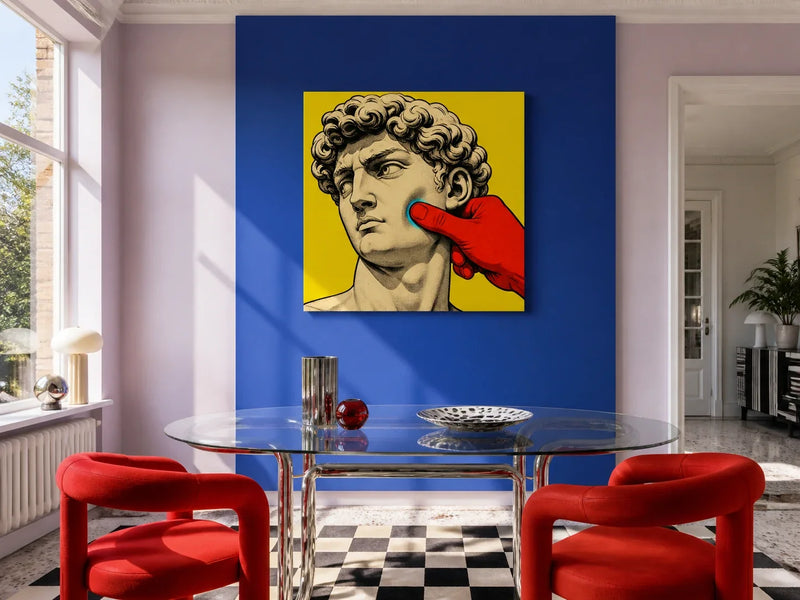
Moving street imagery into a gallery, auction or home alters its meaning. The work gains a stable owner and controlled lighting but loses weather, public access and its original route through the city.
That shift is not automatically a betrayal or a triumph. Artists may choose studio work alongside public practice, and printed work can make a visual language available in another form. The important distinction is honesty. A graffiti-inspired canvas is not the same object as a wall painted in place, even when both use lettering, drips and bold colour.
A better way to read a painted wall
When you encounter graffiti or street art, begin with the evidence in front of you:
- Look at the lettering, figures, colour and materials.
- Notice how the work uses the building, pavement or street furniture.
- Check whether a plaque, festival page or local source identifies the artist and context.
- Avoid assuming that every work speaks for the whole neighbourhood.
- Remember that permission cannot always be determined from appearance alone.
Spray Can Stories looks more closely at characters, tags, throw-ups and pieces. Concrete Canvas explores how larger public works change with their surroundings.
Street art and graffiti continue to resist one simple definition because the city itself keeps changing. The most useful response is not to romanticise every mark or dismiss it all as damage. Look at the form, the place and the people involved, then allow the wall to remain part of the story.